Hanoi Opera House: A Stage for History
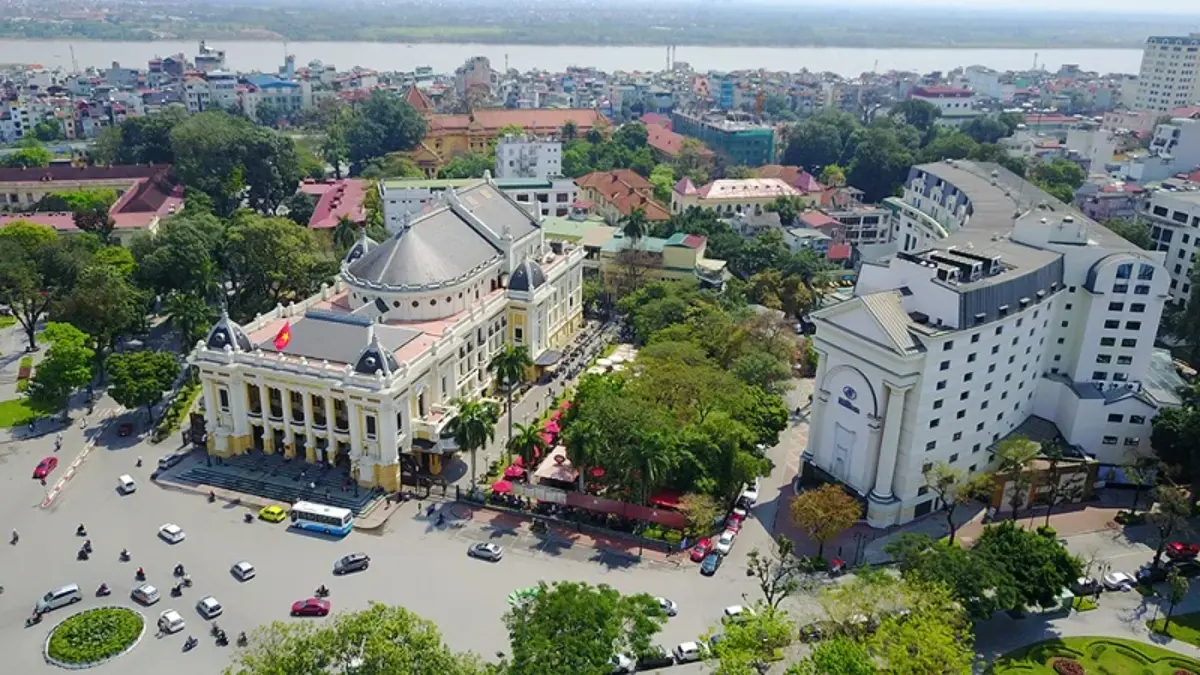
A Neo-Classical Masterpiece
Paris on the Red River
Built between 1901 and 1911, the Hanoi Opera House was modeled on the Palais Garnier in Paris, with adaptations for the tropical climate. The architects, Broyer and Harlay, designed a building that would impress: a grand façade with Corinthian columns, a soaring portico, and intricate stonework. Inside, the auditorium is a masterpiece of French belle époque style, with a ceiling painted by a French artist, a stage framed by gilt, and seating for nearly 600. The building was constructed using materials imported from France — iron, steel, and cement — and was considered the grandest building in Indochina at the time. It was a statement of French power, a piece of Paris transplanted to the banks of the Red River.
The Architecture of Power
Columns, Arches, and Gilt
The opera house’s exterior is defined by its monumental scale. The central entrance is flanked by two rows of Corinthian columns; above them, a frieze of sculpted figures. The building is topped by a dome, visible from the surrounding streets. Inside, the main staircase is a grand affair, with marble steps and wrought‑iron railings. The auditorium is horseshoe‑shaped, with balconies that create intimate viewing angles. The ceiling painting, depicting the goddess of music, was restored in the 1990s after decades of neglect. Every detail — from the chandeliers to the gilded moldings — speaks to the ambition of its creators.
A Witness to Revolution
Where the New Government Was Announced
On August 17, 1945, the Viet Minh used the opera house as a platform to announce the formation of the new revolutionary government. A large crowd gathered in the square before the building, and the red flag with its yellow star was raised above the portico. It was a symbolic moment: the colonial building, a symbol of French power, transformed into a stage for Vietnamese independence. After the August Revolution, the opera house served as the headquarters of the provisional government, and later, as a venue for meetings of the National Assembly. The building’s history is thus inseparable from the history of modern Vietnam.
War and Restoration
A Phoenix from the Ashes
During the Vietnam War, the opera house was used for government meetings and, at times, as a shelter. By the 1980s, it had fallen into disrepair. A major restoration project began in 1995, led by Vietnamese architects and craftsmen. They worked to restore the original materials, to repair the ceiling paintings, and to bring the building back to its former glory. The restoration was completed in 1997, and the opera house reopened with a performance of the Vietnam National Symphony Orchestra. Today, it is once again a center of cultural life, hosting opera, ballet, symphony concerts, and traditional Vietnamese performances.
Performances Today
A Stage for Tradition and Modernity
The Hanoi Opera House is home to the Vietnam National Opera and Ballet, the Vietnam National Symphony Orchestra, and the Vietnam National Drama Theatre. The calendar includes classical European operas, traditional Vietnamese performances, and contemporary productions. The acoustics are excellent, the atmosphere formal, and attending a performance is an occasion. For visitors, it is an opportunity to experience Hanoi’s cultural sophistication and to see the building as it was meant to be experienced: with the lights dimmed, the music playing, and the audience in elegant attire.
Visiting the Opera House
Inside the Masterpiece
While the best way to experience the opera house is to attend a performance, visitors can also take guided tours. Tours are offered in Vietnamese and English and include the grand staircase, the auditorium, and the foyers. The tour provides insight into the building’s architecture and history, and the guides share stories of its role in Vietnamese history. For those who cannot attend a performance, a tour is an excellent alternative. The opera house is also a popular spot for photography, especially at night when the building is illuminated.
Opera House Experiences
Guided Tour: A 30‑45 minute tour of the building’s interior, including the auditorium, staircase, and foyers.
Performance Evening: Attend an opera, ballet, or symphony performance — the most authentic way to experience the venue.
Combined Itinerary: Pair the opera house with the Hanoi Museum of History or the Old Quarter for a comprehensive exploration of Hanoi’s cultural heritage.
Private Guide: For those seeking deeper historical context, a private guide can share the building’s revolutionary significance.
The Essence of the Opera House — The Hanoi Opera House is more than a building; it is a repository of memory. In its walls are echoes of colonial power and revolutionary triumph, of wartime resilience and peacetime renewal. To stand before its façade is to see a monument that has witnessed a century of Vietnamese history. To enter its auditorium is to experience the elegance that has endured through all of it. For visitors to Hanoi, the opera house offers a connection to the city’s cultural soul — and a reminder that even in a city of constant change, some things remain timeless.
Frequently Asked Questions
Yes. Guided tours are offered daily (schedule varies). Alternatively, you can attend a performance, which gives you access to the interior.
Tours are typically offered at 10:00 AM, 11:00 AM, 2:00 PM, and 3:00 PM. It is best to check the schedule in advance.
Tickets can be purchased at the opera house box office or online through authorized vendors. Classical and popular performances sell out in advance.
Formal or semi‑formal attire is expected. Jackets for men, evening dresses or elegant attire for women.
Photography without flash is usually allowed during tours. During performances, photography is prohibited.
Late afternoon for golden light, or at night when the building is illuminated.